Effect of a silvopastoral system with Tithonia diversifolia (Hemsl.) A. Gray on the ruminal microbial community of Siboney de Cuba male cattle
Article Sidebar
Main Article Content
Abstract
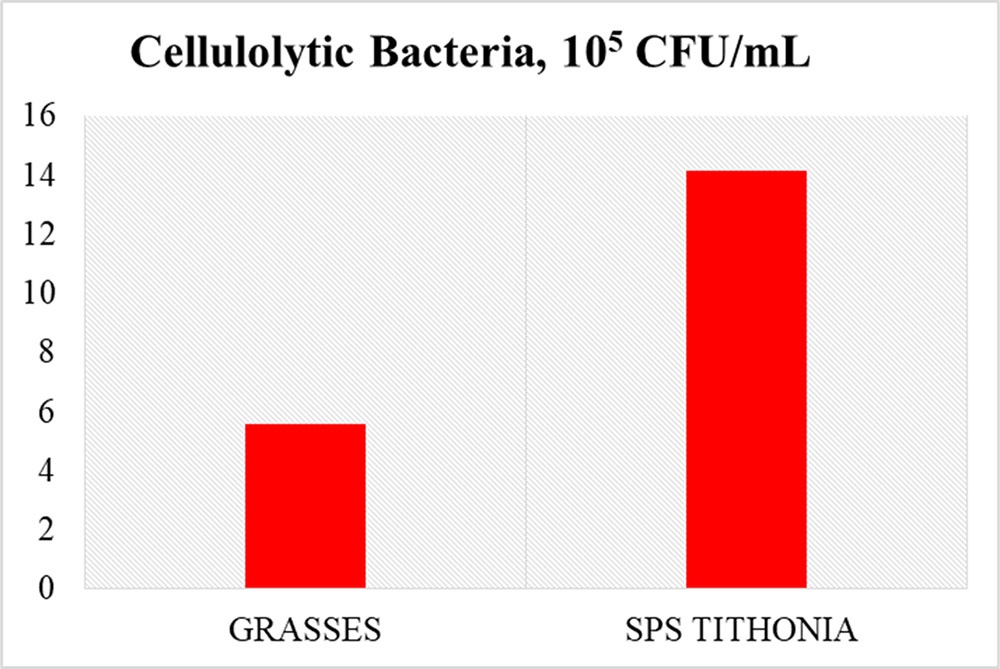
To evaluate the effect of silvopastoral system with Tithonia diversifolia on the ruminal microbial community of Siboney de Cuba genotype cattle in growth-fattening, a total of 24 non-castrated animals were used. Two treatments were established: 1) grazing on improved and natural grasses and 2) grazing in a silvopastoral system of T. diversifolia grasses, associated in 100 % of the area. The animals grazed for 24 hours on 10 hectares (ha) of improved grasses, divided into two systems of 5 ha each. The crude protein in the control treatment was 9.54 %, while in the SPS it was 10.5 % in the grass and 22.7 % in Tithonia. In the rumen of animals that grazed in the SPS with Tithonia, the total number of viable bacteria was higher (p<0.0001), while the proteolytic bacteria were 47.17 x 10⁵ CFU/mL and those of the control treatment, 19.42 x 10⁵ CFU/mL, which represents 2.43 times fewer bacteria. There were no effects on the number of cellulolytic fungi. The silvopastoral system increased the number of cellulolytic bacteria and the protozoa were reduced 3.5 times. Methane production was 37.0472 g/kg of digested OM with grasses and in the SPS with Tithonia 34.788 g/kg of digested OM. It is concluded that the rumen microbial community of Holstein x Zebu non- castrated cattle that grazed in SPS with Tithonia showed a higher number of total viable bacteria, proteolytic bacteria, cellulolytic bacteria, a lower number of protozoa and less CH4 compared to the control that grazed in grass areas.
Article Details

This work is licensed under a Creative Commons Attribution-NonCommercial 4.0 International License.
Those authors that have publications with this journal accept the following terms:
1. They will retain their copyright and guarantee the journal the right of first publication of their work, which will be simultaneously subject to the License Creative Commons Attribution-NonCommercial 4.0 International (CC BY-NC 4.0) that allows third parties to share the work whenever its author is indicated and its first publication this journal. Under this license the author will be free of:
- Share — copy and redistribute the material in any medium or format
- Adapt — remix, transform, and build upon the material
- The licensor cannot revoke these freedoms as long as you follow the license terms.
Under the following terms:
- Attribution — You must give appropriate credit, provide a link to the license, and indicate if changes were made. You may do so in any reasonable manner, but not in any way that suggests the licensor endorses you or your use.
- NonCommercial — You may not use the material for commercial purposes.
- No additional restrictions — You may not apply legal terms or technological measures that legally restrict others from doing anything the license permits.
2. The authors may adopt other non-exclusive license agreements to distribute the published version of the work (e.g., deposit it in an institutional telematics file or publish it in a monographic volume) whenever the initial publication is indicated in this journal.
3. The authors are allowed and recommended disseminating their work through the Internet (e.g. in institutional telematics archives or on their website) before and during the submission process, which can produce interesting exchanges and increase the citations of the published work. (See the Effect of open access).
References
AOAC. 2016. Official methods of analysis of AOAC International. 20 ed., Rockville MD: AOAC International., Latimer, George W. Jr., ISBN: 9780935584875. http://www.worldcat.org/title/official-methods-of-analysis-of-aoac-international/oclc/981578728?referer=null&ht=edition.
Argüello, R., Mahecha- Ledesma, L. & Angulo- Arizala, J. 2020. Perl nutricional y productivo de especies arbustivas en trópico bajo, Antioquia (Colombia). Ciencia y Tecnología Agropecuaria, 21(3): e1700, ISSN: 2500-5308. https://doi.org/10.21930/rcta.vol21_num3_art:1700.
Caldwell, D.R. & Bryant, M.P. 1966. Medium without rumen fluid for nonselective enumeration and isolation of rumen bacteria. Applied Microbiology, 14(5): 794-801, ISSN: 2717-5936. https://doi.org/10.1128/am.14.5.794-801.
Dai, X. & Faciola, A.P. 2019. Evaluating strategies to reduce ruminal protozoa and theirimpacts on nutrient utilization and animal performance in ruminants - A meta analysis. Frontiers in Microbiology, 10: 2648, ISSN: 1664-302X. https://doi.org/10.1007/sl.1250-011-0045-5.
Delgado, D., Galindo, J., González, R. Savón, D., Scull, I., González, N. & Marrero, Y. 2011. Feeding of tropical trees and shrub foliage as a strategy to reduce ruminal methanogenesis: studies conducted in Cuba. Tropical Animal Health and Production, 44(5): 1097-1104, ISSN: 1573-7438. https://doi.org/10.1007/sl.1250-011-0045-5.
dos Santos Silva, A.M., Santos, M.V., da Silva, L.D., dos Santos, J.B., Ferreira, E.A. & Santos, L.D.T. 2021. Effects of irrigation and nitrogen fertilization rates on yield, agronomic efficiency and morphophysiology in Tithonia diversifolia. Agricultural Water Management, 248: 106782, ISSN: 1873-2283. https://doi.org/10.1016/j.agwat.2021.106782.
Elías, A. 1971. The rumen bacteria of animals fed on a high- molasses urea diet. Thesis PhD. Aberdeen.
Galindo, J. 1988. Efecto de la Zeolita en la población microbiana ruminal de vacas que consumen ensilaje. Tesis DrC. Instituto de Ciencia Animal. La Habana.
Galindo, J., González, N., Ruiz, T., Herrera, M., Moreira, O., Capó, A. & Díaz, H. 2022. Effect of three collections of Tithonia diversifolia on the ruminal microbial population of cattle. Cuban Journal of Agricultural Science, 56(1): 1-12, ISSN: 2079-3480. https://cjascience.com/index.php/CJAS/article/view/1039.
Galindo, J.L, La O, O., Ruiz, T., González, A. & Narváez, W. 2018. Efecto de diferentes materiales vegetales de Tithonia diversifolia (Hemsl.) Gray en la población de metanógenos y protozoos del rumen. Revista UNESUM-Ciencias. Revista Científica Multidisciplinaria, 2(3): 98, ISSN: 2602-8166. https://doi.org/10.47230/unesum-ciencias.v2.n3.2018.98.
Galindo-Blanco, J.L., Rodríguez-García, I., González-Ibarra, N., García- López, R. & Herrera-Villafranca, M. 2018. Sistema silvopastoril con Tithonia diversifolia (Hemsl.) A. Gray: efecto en la población microbiana ruminal de vacas. Pastos y Forrajes, 41(4): 273-280, ISSN: 2078-8452. http://scielo.sld.cu/scielo.php?script=sci_arttext&pid=S0864-03942018000400006&Ing=es&tlng=es.
Goering, H.K. & Van Soest, P.J. 1970. Forage fiber analysis (apparatus, reagents, procedures and some applications). US. Agricultural Research Service. 20p.
Guatusmal-Gelpud, C., Escobar-Pachajoa, L.D., Meneses-Buitrago, D.H., Cardona-Iglesias, J.L. & Castro-Rincón, E. 2020. Production and quality of Tithonia diversifolia and Sambucus nigra high andean colombian tropic. Agronomía Mesoamericana, 31(1): 193-208, ISSN: 2215-3608. https://doi.org/10.15517/ma.v31i1.36677.
Hernández-Arboleda, X., Ortiz-Grisales, S., Vivas-Arturo, W.F., Fernández-Romay, Y., La O-León, O., Luiz-Abdalla, A., Pérez-Márquez, S. & Ledea Rodríguez, J.L. 2024. Nutritional value and invitro dry matter degradability in Mexican sunflower: Tithonia diversifolia Hemsl (Gray). Tropical and Subtropical Agroecosystems, 27(3): 094, ISSN: 1870-0462. https://doi.org/10.56369/tsaes.5211.
Hungate, R.G. 1950. The anaerobic, mesophilic cellulolytic bacteria. Bacteriological Reviews, 14(1): 1-49, ISSN: 2691-9443. https://doi.org/10.1128/br.14.1.1-49.1950.
Joblin, K.N. 1981. Isolation, enumeration and maintenance of rumen anaerobic fungi in roll tubes. Applied and Environmental Microbiology, 42(6): 1119-1122, ISSN: 1098-5336. https://doi.org/10.1128/aem.42.6.1119-1122.1981.
Kramer, C.Y. 1956. Extension of multiple range tests to group means with unequal numbers of replications. Biometrics, 12(3): 307-310, ISSN: 0006-341X. https://doi.org/10.2307/3001469.
Króliczewska, B., Pecka-Kielb, E. & Bujok, J. 2023. Strategies used to reduce methane emissions from ruminants: Controversies and issues. Review. Agriculture, 13(3): 602, ISSN: 2077-0472. https://doi.org/10.3390/agriculture13030602.
Levene, H. 1960. Robust tests for the equality of variance. Contributions to Probability and Statistics. Stanford University Press.
da Silva-Macedo, A.J., Costa-Campos, A., Nascimento-Coutinho, D., Soares-Freitas, C.A., dos Anjos, A.J. & Rocha-Bezerra, L. 2022. Efecto de la dieta sobre los parámetros ruminales y la microbiota ruminal: revisión. Revista Colombiana de Ciencia Animal (Recia), 14(1): e886, ISSN: 2027-4297. http://doi.org/10.24188/recia.v14.n1.2022.886.
Palangi, V. & Lackner, M. 2022. Management of enteric methane emissions in ruminants using feed additivies: A Review. Animals, 12(24): 3452, ISSN: 2076-2615. https://doi.org/10.3390/ani12243452.
Pazla, R., Jamarum, N., Agustin, F., Arief, A., Elihasridas, E., Ramaiyulis, R., Yanti, G., Ardani, L.R., Sucitra, L.S. & Ikhlas, Z. 2024. Nutrition profile and rumen fermentatiun of Tithonia diversifolia fermented with Lactobacillus bulgaricus at different dosis. Journal of Advanced Veterinary and Animal Research, 11(1): 146-152, ISSN: 2311-7710. https://doi.org/10.5455/javar.2024.k759.
Pérez-Can, G.E., Tzec-Gamboa, M., Albores-Moreno, S., Sanginés-García, J., Aguilar-Urquizo, E., Chay-Canul, A., Canul-Solis, J., Muñoz-Gonzalez, J., Diaz-Echeverria, V. & Piñero-Vázquez, A.T. 2021. Degradabilidad y producción de metano in vitro del follaje de árboles y arbustos con potencial en la nutrición de rumiantes. Acta Universitaria, 30: e2480, ISSN: 2007-9621. http://scielo.org.mx/scielo.php?script=sci_arttext&pid=S0188-62662020000100129&Ing=es&tlng=es.
Rai, P.K., Soo Lee, S., Bhardwaj, N. & Kim, K-H. 2023. The environmental, socio-economic, and health effects of invasive alien plants: Review on Tithonia diversifolia (Hemsl.) A. Gray in Asteraceae. South African Journal of Botany, 62: 461-480, ISSN: 1727-9321. http://doi.org/10.1016/j.sajb.2023.09.038.
Rivera, J.E., Ruiz, T.E., Chara, J., Gómez- Leiva, J.F. & Barahona, R. 2021. Biomass production and nutritional properties of promising genotypes of Tithonia diversifolia (Hemsl.) A. Gray under different environments. Tropical Grasslands-Forrajes Tropicales, 9(3): 280-291, ISSN: 2346-3775. http://doi.org/10.17138/tgft(9)280-291.
Ruiz, T.E., Alonso, J., Febles, G.J., Galindo, J.L., Savón, L.L., Chongo, B.B., Martínez, Y., La O, O., Cino, D.M., Crespo, G.J., Mora, L., Valenciaga, N., Padilla, C., Rodríguez, B., Muir, L., Rivero A. & Hernández, N. 2017. Evaluación de materiales recolectados de Tithonia diversifolia (Hemsl) Gray en Cuba. Editores: Chará J, Peri P y Rivera J. IX Congreso Sistemas Silvopastoriles. Aporte a los objetivos de desarrollo sostenible, CIPAV. Cali, Colombia. Fundación CIPAV, pág. 486.
Ruiz, T.E., Febles, G., Torres, V., González, J., Achang, G., Sarduy, L. & Díaz, H. 2010. Assessment of collected materials of Tithonia diversifolia (Hemsl.) Gray in the center-western región of Cuba. Cuban Journal of Agricultural Science, 44(3): 291-296, ISSN: 2079-3480. https://cjascience.com/index.php/CJAS/article/view/223.
SAS. 2007. SAS/STAT Software. Version 9 Edition, SAS Institute Inc., Cary, NC. Available at: http://www.sas.com/.
SAS 2013. SAS/IML 9.3 User’s Guide.SAS Institute Inc., Cary, NC. Available at: http://www.sas.com/.
Sauvant, D., Giger-Reverdin, S., Serment, A. & Broudiscou, I. 2011. Influences des régimes et de leur fermentation dans le rumen sur la production de methane par les ruminants. Productions animales, 24(5): 433-446, ISSN: 2824-3633. http://doi.org/10.20870/productions-animales.2011.24.5.3276.
Shapiro, S. & Wilk, B. 1965. An analysis of variance test for normality (complete simples). Biometrika, 52(3-4): 591-611, ISSN: 1464-3510. https://doi.org/10.2307/2333709.
Zhao, L., Hu, Z., Li, S., Zhang, L., Yu, P., Zhang, J., Zheng, X., Rahman, S. & Zhang, Z. 2020. Tagitinin A from Tithonia diversifolia provides resistance to tomato spotted wilt orthotospovirus by inducing systemic resistance. Pesticide Biochemistry and Physiology, l69: 104654, ISSN: 1095-9939. https://doi.org/10.1016/j.pestbp.2020.104654.