In situ degradability of dry matter from four forage protein plants: Erythrina variegata, Leucaena leucocephala, Moringa oleifera and Neonotonia wightii
Article Sidebar
Main Article Content
Abstract
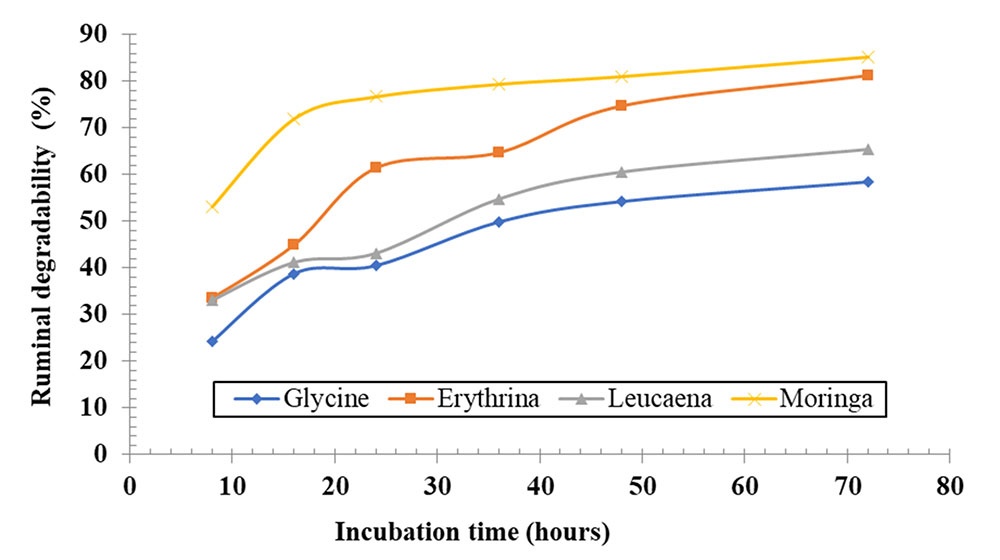
To determine the in situ degradability of dry matter of: Erythrina variegata, Leucaena leucocephala, Moringa oleifera and Neonotonia wightii (Glycine), two cannulated male sheep of Pelibuey breed, weighing 36 kg, were used. Incubation times of 0, 8, 16, 24, 36, 48 and 72 hours were used and the rumen bag method was applied. The trend in ruminal degradability was increasing in the order: Glycine, Leucaena, Erythrina and Moringa. For Moringa, a higher value of ruminal degradability was obtained at 72 hours, greater than 80 %, as well as effective degradability (59.35 %). It is concluded that, although the plants are promising for ruminant feeding, Moringa showed superior indicators in the parameters of ruminal degradation and in situ degradability of dry matter. Ruminal degradability studies are required that relate cutting frequency and secondary metabolite effects.
Article Details

This work is licensed under a Creative Commons Attribution-NonCommercial 4.0 International License.
Those authors that have publications with this journal accept the following terms:
1. They will retain their copyright and guarantee the journal the right of first publication of their work, which will be simultaneously subject to the License Creative Commons Attribution-NonCommercial 4.0 International (CC BY-NC 4.0) that allows third parties to share the work whenever its author is indicated and its first publication this journal. Under this license the author will be free of:
- Share — copy and redistribute the material in any medium or format
- Adapt — remix, transform, and build upon the material
- The licensor cannot revoke these freedoms as long as you follow the license terms.
Under the following terms:
- Attribution — You must give appropriate credit, provide a link to the license, and indicate if changes were made. You may do so in any reasonable manner, but not in any way that suggests the licensor endorses you or your use.
- NonCommercial — You may not use the material for commercial purposes.
- No additional restrictions — You may not apply legal terms or technological measures that legally restrict others from doing anything the license permits.
2. The authors may adopt other non-exclusive license agreements to distribute the published version of the work (e.g., deposit it in an institutional telematics file or publish it in a monographic volume) whenever the initial publication is indicated in this journal.
3. The authors are allowed and recommended disseminating their work through the Internet (e.g. in institutional telematics archives or on their website) before and during the submission process, which can produce interesting exchanges and increase the citations of the published work. (See the Effect of open access).
References
AOAC, 1995. Official Methods of Analysis. 16th Ed. Assoc. Off. Agric. Chem. Washington, D.C.
Ascencio-Rojas, L., Valles-de la Mora, B., Castillo-Gallegos, E. & Ibrahim, M. 2019. In situ ruminal degradation and effective degradation of foliage from six tree species during dry and rainy seasons in Veracruz, Mexico. Agroforestry Systems, 93: 123-133, ISSN: 1572-9680. https://doi.org/10.1007/s10457-018-0184-z.
Chen, X. B. 2000. NEWAY: Curve fitting programme software for Orskov’s model (DOS version). International Feed Resources Unit, Macaulay Land Use Research Institute, Aberdeen, Scotland.
Choque-Durand, H., Huaita, A., Cárdenas, L.A. & Ramos, R. 2018. Effect of regrowth age in the ruminal degradation of pisonay (Erythrina sp) in Andean valley of Abancay. Journal of High Andean Research, 20(2): 189 - 202, ISSN: 2313-2957. http://doi.org/10.18271/ria.2018.363.
Elizondo-Salazar, J.A. & Monge-Rojas, C.R. 2020. Fistulación en bovinos y uso de la técnica de degradabilidad ruminal para análisis de alimentos. Nutrición Animal Tropical, 14(2): 209-229, ISSN: 2215-3527. http://dx.doi.org/10.15517/nat.v14i2.45167.
Gutiérrez, D., Borjas, E., Rodríguez, R., Rodríguez, Z., Stuart, R. & Sarduy, L. 2015. Evaluación de la composición química y degradabilidad ruminal in situ de ensilaje mixto con Pennisetum purpureum cv. Cuba CT-169: Moringa oleifera. Avances en Investigación Agropecuaria, 19(3): 7-16, ISSN: 2638-1716. http://www.redalyc.org/articulo.oa?id=83743886002.
Gutiérrez, F., Sacido, M. & Feldman, S. 2024. Efecto sinérgico de las mezclas de raigrás perenne con trébol sobre la degradabilidad ruminal. Nutrición Animal Tropical, 18(2): 56-80, ISSN: 2215-3527. https://doi.org/10.15517/nat.v18i2.61798.
La O, O., González, H., Vázquez, M.C., Hernández, J., Estrada, A. & Ledea, J.L. 2018. Nutritional characterization of Gliricidia sepium in a saline and high drought ecosystem of the Cauto river basin, Cuba. Cuban Journal of Agricultural Science, 52(3): 347-356, ISSN: 2079-3480. https://cjascience.com/index.php/CJAS/article/view8256.
McDonald, I. 1981. A revised model for the estimation of protein degradability in the rumen. The Journal of Agricultural Science, 96(1): 251-252, ISSN: 1469-5146. https://doi.org/10.1017/S0021859600032081.
Mehrez, A.Z. & Ørskov, E.R. 1977. A study of artificial fibre bag technique for determining the dig estibility of feeds in the rumen. The Journal of Agricultural Science, 88(3): 645-650, ISSN: 1469-5146. https://doi.org/10.1017/S0021859600037321.
Meza-Bone, G., Meza-Bone, C., Avellaneda-Cevallo, J., Godoy-Montiel, L., Barros-Rodríguez, M. & Jines-Fernández, F. 2022. In vitro ruminal degradation of Tithonia diversifolia. Agronomía Mesoamericana, 33(1): 43206, ISSN: 2215-3608. https://doi.org/10.15517/am.v33i1.43206.
Ørskov, E.R. 2002. Trails and trails in Livestock Research. Abeerden. Garamond. pp.204.
Ørskov, E.R. & McDonald, I. 1979. The estimation of protein degradability in the rumen from incubation measurements weighted according to rate of passage. The Journal of Agricultural Science, 92(2): 499-503, ISSN: 0021-8596. https://doi.org/10.1017/S0021859600063048.
Sosa-Pérez, G., López-Ortiz, S., Pérez-Hernández, P., Vaquera-Huerta, H., Galván, M.M. & Gallegos-Sánchez, J. 2023. Degradability of the dry matter and crude protein of fruits of Chloroleucon manguense and Acacia cochliacantha in sheep. Pesquisa Agropecuária Brasileira, 58: e03026, ISSN: 1678-3921. https://doi.org/10.1590/S1678-3921.pab2023.
Valenciaga, D., López, J.R., Galindo, J., Ruiz, T. & Monteagudo, F. 2018. Cinética de degradación ruminal de materiales vegetales de Tithonia diversifolia recolectados en la región oriental de Cuba. Livestock Research for Rural Development, 30(11): 186, ISSN: 0121-3784. http://www.lrrd.org/lrrd30/11/daiky30186.html.