Use of vinasse as an additive in silages of Tithonia diversifolia (Hemsl) L. vc. IcaCuba Occ-10, alone and in mixture with Cenchrus purpureus cv. CT-608
Article Sidebar
Main Article Content
Abstract
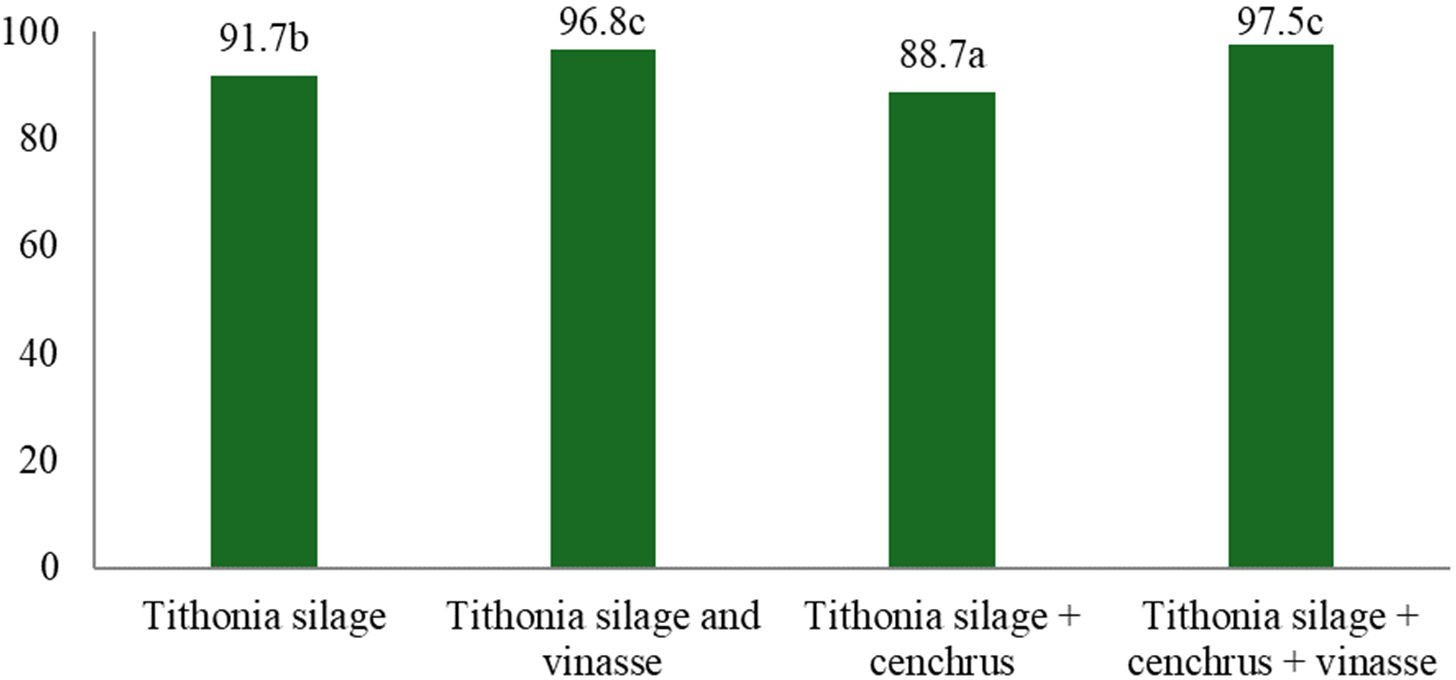
To evaluate the quality of silages of Tithonia diversifolia vc. IcaCuba Occ-10, alone or mixed with forage of Cenchrus purpureus cv. CT-608, preserved with or without vinasse, a completely random design was used, with a factorial arrangement (2x2) and 10 microsilos per treatment. All treatments showed similar dry matter content (P>0.05), lower than the recommended values (30-35 %). The inclusion of vinasse reduced the pH compared to the treatment without it (P<0.01). similarly, the dry matter:pH ratio improved when vinasse was included as an additive. The treatments of Tithonia alone showed a dark green color, the mixture of Tithonia and Cenchrus forages resulted in olive green with dark tones that disappeared when vinasse was added. It was the latter that had a coloration most in line with an excellent quality silage. In the silages with vinasse, a pleasant smell was obtained, similar to that suggested for silages of very good characteristics. The silages obtained from T. diversifolia, alone or mixed with C. purpureus cv. CT-608 forage, showed sufficient quality indicators to recommend their evaluation on a larger scale, even starting from materials with low dry matter contents. The organoleptic and chemical evaluation supports its stability and acceptability. The inclusion of vinasse in the preservation process of these silages is confirmed as an economical and effective strategy for the conservation of tropical forages, even forages with high protein content and high buffering capacity such as tithonia. Its use as an additive reduces the acid detergent fiber content, pH, and improves dry matter yield, the dry matter:pH ratio, and its organoleptic characteristics, such as color and odor.
Article Details

This work is licensed under a Creative Commons Attribution-NonCommercial 4.0 International License.
Those authors that have publications with this journal accept the following terms:
1. They will retain their copyright and guarantee the journal the right of first publication of their work, which will be simultaneously subject to the License Creative Commons Attribution-NonCommercial 4.0 International (CC BY-NC 4.0) that allows third parties to share the work whenever its author is indicated and its first publication this journal. Under this license the author will be free of:
- Share — copy and redistribute the material in any medium or format
- Adapt — remix, transform, and build upon the material
- The licensor cannot revoke these freedoms as long as you follow the license terms.
Under the following terms:
- Attribution — You must give appropriate credit, provide a link to the license, and indicate if changes were made. You may do so in any reasonable manner, but not in any way that suggests the licensor endorses you or your use.
- NonCommercial — You may not use the material for commercial purposes.
- No additional restrictions — You may not apply legal terms or technological measures that legally restrict others from doing anything the license permits.
2. The authors may adopt other non-exclusive license agreements to distribute the published version of the work (e.g., deposit it in an institutional telematics file or publish it in a monographic volume) whenever the initial publication is indicated in this journal.
3. The authors are allowed and recommended disseminating their work through the Internet (e.g. in institutional telematics archives or on their website) before and during the submission process, which can produce interesting exchanges and increase the citations of the published work. (See the Effect of open access).
References
AOAC (Association of Official Analytical Chemists). 2016. Official Methods of Analysis of AOAC International. 20th Ed. George W. Latimer Jr (ed). Ed. AOAC International, Rockville MD, USA, ISBN: 978-0935-584-875. Available at: http://www.directtextbook.com/isbn/9780935584875, [Consulted: October 13, 2025].
Arias, L.M., López, M., Castillo, M. & Alpízar, A. 2023. Fertilization type and regrowth age of Tithonia diversifolia on ruminal parameters. Agronomía Mesoamericana, 34(3): 53192, ISSN: 2215-3608. https:// doi.org/10.15517/am.2023.53192.
Ávila, C.L.S., Carvalho, B.F. & Pinto, J.C. 2022. Silage production in the tropics: Forage sources, additives and challenges. In: Silage Vol. 2. IntechOpen. https://doi.org/ 10.5772/intechopen.102579.
Chaverra Gil, H. & Eusse, J.B. 2000. Ensilaje en la alimentación de ganado vacuno. IICA. Tercer Mundo Editores. Bogotá, Colombia. 123 p, ISBN: 958-9328-26_1.
Di Rienzo, J.A., Casanoves, F., Balzarini, M.G., González, L., Tablada, M. & Robledo, C.W. 2012. InfoStat. version 2012, [Windows], Universidad Nacional de Córdoba, Argentina: Grupo InfoStat. Available at: https://www.infostat.com.ar.
Duncan, D.B. 1955. Multiple Range and Multiple F Tests. Biometrics, 11(1): 1-42, ISSN: 1541-0420. https:// doi.org/10.2307/3001478.
Gutiérrez, D., Borjas-Rojas, E., Rodríguez-Hernández, R., Rodríguez, Z., Stuart, R. & Sarduy, L. 2015. Evaluación de la composición química y degradabilidad ruminal in situ de ensilaje mixto con Cenchrus purpureus cv. Cuba CT-169: Moringa oleifera. Avances en Investigación Agropecuaria, 19(3): 7-16, ISSN: 0188-7890.
Hernández, J.A., Pérez, J.J.M., Bosch, I.D. & Castro, S.N. 2015. Clasificación de los suelos de Cuba 2015. Mayabeque, Cuba: Ediciones INCA, 93 p., ISBN: 978-959-7023-77-7.
Ku Vera, J.C., Briceño, E.G., Ruiz, A., Mayo, R., Ayala, A.J., Aguilar, C.F., Solorio, F.J. & Ramírez, L. 2014. Manipulation of the energy metabolism of ruminants in the tropics: options for improving meat and milk production and quality. Cuban Journal of Agricultural Science, 48(1): 43-53, ISSN: 2079-3480. https://www.cjascience.com/in- dex.php/CJAS/article/view/426.
Kung, L., Shaver, R.D., Grant, R.J. & Schmidt, R.J. 2018. Silage review: Interpretation of chemical, microbial, and organoleptic components of silages. Journal of Dairy Science, 101(5): 4020-4033, ISSN: 1525-3198. https:// doi.org/10.3168/jds.2017-13909.
Li, Y., Nishino, N. & Wang, Y. 2022. Effects of bacterial inoculants and enzymes on the fermentation quality and bacterial community of Mulberry silage. Animal Bioscience, 35(6): 933-941, ISSN: 2765-0189. https:// doi.org/10.5713/ab.21.0412.
McDonald, P., Henderson, A.R., Heron, S.J.E. 1991. The Biochemistry of Silage (Second edition). Marlow Bucks, UK: Chalcombe Publications, pp.340, ISBN: 0-948617-225.
Morales, D., Rodríguez, R., Fundora, L., García, F., Ojeda, F. & López, O. 2019. Fermentative quality of sorghum (Sorghum bicolor L. Moench) and citrus fruit (Citrus sp.) pulp silage. Pastos y Forrajes, 42(3): 207-212, ISSN: 2078-8452. http://scielo.sld.cu/scielo.php?script=sci_art- text&pid=S0864-03942019000300207&lng=es&tlng=es. Morales, D., Rodríguez, R., López, O., Ojeda, F., Camejo, D., García, F. & Fundora, L. 2022. Chemical and organoleptic evaluation of silages of Sorghum bicolor (L.) Moench and Citrus sp. pulp. Pastos
y Forrajes, 45: eI17, ISSN: 2078-8452. http://scie- lo.sld.cu/pdf/pyf/v45/en_2078-8452-pyf-45-e17.pdf.
Ojeda, F., Cáceres, O. & Esperance, M. 1991. Sistema de evaluación para ensilajes tropicales. En: Conservación de forrajes. Ciudad de La Habana. Editorial Pueblo y Educación. p. 15-65
Ontivero, Y. 2021. Caracterización de cinco arbustivas proteicas promisorias para la ganadería cubana. Pastos y Forrajes, 44: eE10, ISSN: 2078-8452. http://scielo.sld.cu/scielo.php?script=sci_art- text&pid=S0864-03942021000100010&lng=es&tlng=es.
Prado, R.M., de Carvalho, L.G. & Daurício, J.A. 2023. Vinasse as a sustainable additive for animal feed: A review. Waste and Biomass Valorization, 14(2): 385-402, ISSN: 1877-265X. https://doi.org/10.1007/s12649-022-01863-1.
Rojas-Cordero, D., Alpízar-Naranjo, A., Castillo-Umaña, M. & López-Herrera, M. 2020. Efecto de la inclusión de Musa sp. en la conservación de Morus alba Linn. Pastos y Forrajes, 43(3): 210-219, ISSN: 2078-8452. http://scielo.sld.cu/scielo.php?script=sci_art- text&pid=S0864-03942020000300210&lng=es&tlng=es.
Rodríguez-Oliva, M., Ojeda, F., Pozo, Y., Rondón, A.J. & Milián, G. 2022. Evaluation of two microbial inoculants as fermentation activators in silages of Tithonia diversifolia (Hemsl.) A. Gray. Pastos y Forrajes, 45: eE22, ISSN: 2078-8452. http://scielo.sld.cu/scielo.php?script=sci_art- text&pid=S0864-03942022000100022&lng=es&tlng=es.
Ruiz, T.E., Rodríguez, B., Padilla, C., Valenciaga, N., Lok, S., Galindo, J., Savón, L., Chongo, B., La O, O., Torres, V., Gutiérrez, D., Scull, I., Rodríguez, R., Valenciaga, D., López, J.R., Alonso, J., Medina, Y., Cino, D.M., Vázquez, Y. & Castro, J.A. 2021. Tithonia diversifolia Another Bush Alternative for Use in Silvopastoral Systems in Cuba. Avances de Investigación Agropecuaria, 25(3): 211-214, ISSN: 0188-7890. https://doi.org/10.53897/Re- vAIA.21.25.64.
Sánchez, T., Ruz, F., Morales, D., Olivera, Y., Rizo, M. & Benitez, M. 2021. Calidad fermentativa y organoléptica de ensilajes con diferentes proporciones de forraje y raíz de Manihot esculenta Crantz. Pastos y Forrajes, 44: eE25, ISSN: 2078-8452. http://scie- lo.sld.cu/pdf/pyf/v44/2078-8452-pyf-44-eE25.pdf.
Sánchez, W. 2018. Potencial de los forrajes para producir ensilajes de calidad. Alcances Tecnológicos, 12(1): 49-58, ISSN: 1659-0538. https://doi.org/10.35486/at.v12i1.37.
Van Soest, P.J., Robertson, J.B. & Lewis, B.A. 1991. Methods for Dietary Fiber, Neutral Detergent Fiber, and Nonstarch Polysaccharides in Relation to Animal Nutrition. Journal of Dairy Science, 74(10): 3583-3597, ISSN: 1525-3198. https://doi.org/10.3168/jds.S0022-0302(91)78551-2.