Biological evaluation of Cuban ensiled food (CEF) in broilers feeding
Article Sidebar
Main Article Content
Abstract
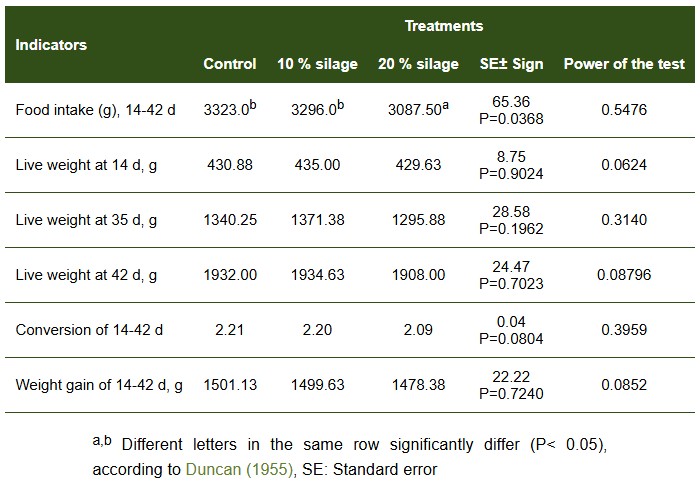
A total of 600 unsexed EB34 hybrid broilers were used from 14 days of age to evaluate productive parameters, edible portion weight and abdominal fat, by replacing part of the diet with Cuban ensiled food (CEF). The birds were distributed according to a completely random design into three treatments, with eight repetitions each, in which the control diet was partially replaced by 10 and 20 % of CEF taking into account the dry matter of the diet and the silage. Live weight, food intake, weight gain, and feed conversion were analyzed. For the edible portions, the carcass was cleaned and the weight of carcass, breast, abdominal fat, drumsticks and thigh was recorded. The resulting data were analyzed using the InfoStat statistical package. Although a decrease in intake was shown as the percentage of substitution increased (3323.0, 3296.0 and 3087.5 g, respectively), the live weight of the birds was not affected, which favored the introduction of this food into the broilers feeding. However, the study of edible portions showed that a 10 % substitution favors breast weight. The results show that it is possible to replace up to 20 % of the diet with CEF in broilers, without affecting behavioral indicators or the weight of edible portions, demonstrating the potential of this product in broilers breeding.
Article Details

This work is licensed under a Creative Commons Attribution-NonCommercial 4.0 International License.
Those authors that have publications with this journal accept the following terms:
1. They will retain their copyright and guarantee the journal the right of first publication of their work, which will be simultaneously subject to the License Creative Commons Attribution-NonCommercial 4.0 International (CC BY-NC 4.0) that allows third parties to share the work whenever its author is indicated and its first publication this journal. Under this license the author will be free of:
- Share — copy and redistribute the material in any medium or format
- Adapt — remix, transform, and build upon the material
- The licensor cannot revoke these freedoms as long as you follow the license terms.
Under the following terms:
- Attribution — You must give appropriate credit, provide a link to the license, and indicate if changes were made. You may do so in any reasonable manner, but not in any way that suggests the licensor endorses you or your use.
- NonCommercial — You may not use the material for commercial purposes.
- No additional restrictions — You may not apply legal terms or technological measures that legally restrict others from doing anything the license permits.
2. The authors may adopt other non-exclusive license agreements to distribute the published version of the work (e.g., deposit it in an institutional telematics file or publish it in a monographic volume) whenever the initial publication is indicated in this journal.
3. The authors are allowed and recommended disseminating their work through the Internet (e.g. in institutional telematics archives or on their website) before and during the submission process, which can produce interesting exchanges and increase the citations of the published work. (See the Effect of open access).
References
Al-abdullatif, A.A., Al-Garadi, M. A., Qaid, M. M., Matar, A. M., Alobre, M. M., Al-Badwi, M. A. & Hussein, E.O. (2024). Synergistic effects of RISCO-NUTRIFOUR probiotic mixtures as feed additives on growth performance and carcase characteristics of broiler chickens over 28 days. Italian Journal of Animal Science, 24(1): 33-42, ISSN: 1828-051X. https://doi.org/10.1080/1828051X.2024.2436955.
Betancourt, J., Núñez, L.A. & Castaño, J.G. (2017). Suministro de ensilaje de Tithonia diversifolia sólo o mezclado con afrecho de yuca en la dieta de pollos de engorde. Tropical and Subtropical Agroecosystems, 20(2): 203-213, ISSN: 1870-0462. https://www.redalyc.org/articulo.oa?id=93952506005.
Brickett, K.E., Dahiya, J.P., Classen, H.L. & Gomis, S†. (2007). Influence of dietary nutrient density, feed form, and lighting on growth and meat yield of broiler chickens. Poultry Science, 86: 2172-2181, ISSN: 1525-3171. https://doi.org/10.1093/ps/86.10.2172.
Di Rienzo, J.A., Casanoves, F., Balzarini, M.G., González, L., Tablada, M. & Robledo, C.W. (2012). INFOSTAT. Universidad Nacional de Córdoba, Argentina. Available at: http://www.infostat.com.ar.
Duncan, D.B. (1955). Multiple range and multiple F. tests. Biometrics, 11: 1-42, ISSN: 1541-0420. https://doi.org/10.2307/3001478.
Fernández-García, F.G., Irigoyen, M.J., Rodríguez, C., Arroyo, J.M., Brambillasca, S., Repetto, J.L., & Cajarville, C. (2025). Reconstitución de granos de maíz y sorgo: Efectos sobre la digestibilidad aparente en pollos de engorde. Veterinaria (Montevideo), 61(Suplemento 1): 184, ISSN: 1688-8228. https://www.revistasmvu.com.uy/index.php/smvu/article/view/1465.
García-López, R. Lezcano, P. & González, M.R. (2021). Cuban ensiled feed and response of dairy cows. Cuban Journal of Agricultural Science, 55(3): 285-290, ISSN: 2079-3480. https://www.cjascience.com/index.php/CJAS/article/view/1027.
Gaviria, Y.S, Figueroa, O.A. & Zapata, J.E. (2021). Efecto de la inclusión de ensilado químico de vísceras de tilapia roja (Oreochromis spp.) en dietas para pollos de engorde sobre los parámetros productivos y sanguíneos. Información Tecnológica, 32(3): 79-88, ISSN: 0718-0764. http://dx.doi.org/10.4067/S0718-07642021000300079.
Gómez G. M., Ortiz. M. A, Perea, C. & López, F.J. (2014). Evaluación del ensilaje de vísceras de tilapia roja (Oreochromis spp) en alimentación de pollos de engorde. Biotecnología en el Sector Agropecuario y Agroindustrial, 12(1): 106-114, ISSN: 1909-9959. https://dialnet.unirioja.es/servlet/articulo?codigo=6117841.
Hidalgo, K., Bocourt, R., Mora, L. & Albelo. A. (2017). Physical-chemical and microbiological characterization of the concentrated vinasse from alcohol distillery. Cuban Journal of Agricultural Science, 51(4): 459-469, ISSN: 2079-3480. https://www.cjascience.com/index.php/CJAS/article/view/747/769.
Hidalgo, K., Rodríguez, B., Valdivié, M. & Febles, M. (2009). Utilización de la vinaza de destilería como aditivo para pollos en ceba. Revista Cubana de Ciencia Agrícola, 43(3): 281-284, ISSN: 0034-7485. https://www.redalyc.org/articulo.oa?id=193015481011.
Lezcano, P., Martínez, M., Vázquez, A. & Pérez, O. (2017). Main methods of processing and preserving alternative feeds in tropical areas. Cuban experience. Cuban Journal of Agricultural Science, 51(1): 1-10, ISSN: 2079-3480. https://www.cjascience.com/index.php/CJAS/article/view/679.
Lezcano, P., Vázquez, A., Bolaños, A., Piloto, J. L., Martínez, M., & Rodríguez, Y. (2016). Silage of alternative feeds of Cuban origin, a technical, economical and environmental option for the production of pork meat. Cuban Journal of Agricultural Science, 49(1): 65-69, ISSN: 2079-3480. https://www.cjascience.com/index.php/CJAS/article/view/549.
Martínez, M., Vives, Y., Rodríguez, B. & Pérez, O. (2021). Calidad de la canal y la carne en pollos de ceba que consumen Roystonea regia. Revista MVZ Córdoba, 26(2): e1984, ISSN: 0122-0268. https://doi.org/10.21897/rmvz.1984.
Pérez, M., Milián, G., Bocourt, R. & Caicedo, W. (2020). Efecto de una levadura hidrolizada sobre el comportamiento y estado inmunológico de pollos de ceba. Livestock Research for Rural Development, 32, Article #145, ISSN: 0121-3784. http://www.lrrd.org/lrrd32/9/orlan32145.html.
Quishpe, X., Silva, L., Chacón, E., Toro B. & Garzon, R. (2023). Empleo de la harina de Brassica oleracea en la alimentación de pollos de ceba. Revista Científica y Tecnológica UPSE, 10(2): 1-10, ISSN: 1390-7697. https://doi.org/10.26423/rctu.v10i2.723.
Rodríguez Galvis, J.C. (2012). Respuesta morfométrica intestinal de pollos alimentados con diferentes niveles de Morera (Morus alba). Revista CITECSA, 3(4): 28-37, ISSN: 2027-6745. https://mvz.unipaz.edu.co/revistas/revcitecsa/article/view/26.
Rostagno, H., Albino, L.T., Donzele, J.L., Gomes, P.C., de Oliveira, R.F., Lopes, D.C., Ferreira, A. & de Toledo, S.L. (2017). Tablas Brasileras para Aves y Cerdos. Composición de Alimentos y Exigencias Nutricionales. Ed. Horacio Rostagno. 3 era Edición. Vicosa, U.F.V. Brasil, 250 pp. Available at: https://eliasnutri.wordpress.com/wp-content/uploads/2018/09/tablas-brasilec3b1as-aves-y-cerdos-cuarta-edicion-2017-11.pdf.
Sánchez, A. (1990). Enfermedades de las aves. Editorial ENPES. La Habana. 285pp.
Sarmiento-Franco, L., Santos-Ricalde, R. & Sandoval-Castro, C. (2021). Aportaciones de la FMVZ-UADY al conocimiento sobre la alimentación de cerdos, aves y conejos con recursos tropicales. Tropical and Subtropical Agroecosystems, 24(2): 66, ISSN: 1870 - 0462. https://www.revista.ccba.uady.mx/ojs/index.php/TSA/article/view/3688/1608.