Potential of heat-treated dehulled seed of Lupinus angustifolius on egg production, feed intake and egg quality characteristics in commercial chickens
Article Sidebar
Main Article Content
Abstract
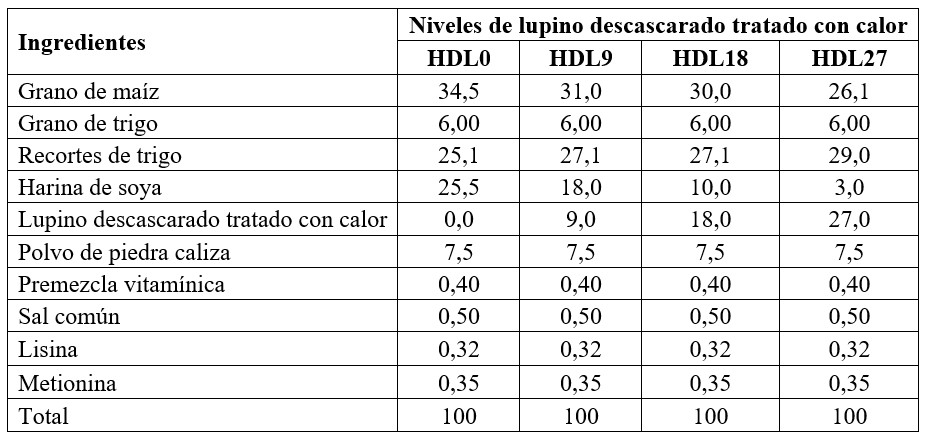
This study was conducted to investigate the effect of substitution of soybean meal as partial replacement of heat-treated-dehulled lupin (Lupinus angustifolius meal, HDL) on the productivity and egg quality from Lohmann Brown laying hens. One hundred sixty laying hens were randomly assigned to four treatment diets replicated four times with ten birds each. The dietary treatments were the control diet without HDL (HDL0) and diets containing HDL at 9 % (HDL9), 18 % (HDL18) and 27 % (HDL27). The results indicated that egg production, egg weight, egg mass and feed conversion ratio did not change due to the effect of the experimental groups, except for feed intake. Hens fed HDL0 had higher (P<0.05) feed intake than those fed HDL27 diet. Hen-housed egg production was recorded at 48.3 %, 47.3 %, 50.5 %, and 47.0 % for the HDL0, HDL9, HDL18, and HDL27 diets, respectively. The corresponding average daily feed intake for hens fed on HDL0, HDL9, HDL18, and HDL27 diets was 107 g, 106 g, 105 g, and 102 g. Egg mass per hen for these diets measured 2.84 kg, 2.74 kg, 2.97 kg and 2.72 kg, in that order. The feed conversion ratio (kg feed/kg egg mass) ranged from 3.94 with HDL18 to 4.23 with HDL27 diets. Internal egg qualities were not significantly influenced by the dietary treatments. Dry shell weight, eggshell ratio, and density for hens receiving HDL9 and HDL18 diets were comparable to those observed in the control group. Egg weight, egg length, egg width, yolk height, yolk width, albumen height, and Haugh unit score increased with advancing age (P<0.05). In conclusion, replacing soybean with up to 18 % HDL resulted in observable effects on the nutritional quality and performance metrics of hens.
Article Details

This work is licensed under a Creative Commons Attribution-NonCommercial 4.0 International License.
Those authors that have publications with this journal accept the following terms:
1. They will retain their copyright and guarantee the journal the right of first publication of their work, which will be simultaneously subject to the License Creative Commons Attribution-NonCommercial 4.0 International (CC BY-NC 4.0) that allows third parties to share the work whenever its author is indicated and its first publication this journal. Under this license the author will be free of:
- Share — copy and redistribute the material in any medium or format
- Adapt — remix, transform, and build upon the material
- The licensor cannot revoke these freedoms as long as you follow the license terms.
Under the following terms:
- Attribution — You must give appropriate credit, provide a link to the license, and indicate if changes were made. You may do so in any reasonable manner, but not in any way that suggests the licensor endorses you or your use.
- NonCommercial — You may not use the material for commercial purposes.
- No additional restrictions — You may not apply legal terms or technological measures that legally restrict others from doing anything the license permits.
2. The authors may adopt other non-exclusive license agreements to distribute the published version of the work (e.g., deposit it in an institutional telematics file or publish it in a monographic volume) whenever the initial publication is indicated in this journal.
3. The authors are allowed and recommended disseminating their work through the Internet (e.g. in institutional telematics archives or on their website) before and during the submission process, which can produce interesting exchanges and increase the citations of the published work. (See the Effect of open access).
References
Abraham, E.M., Ioannis. G., Panagiotis, M., Athanasios, M., Photini, M., Irini, N., Zoi, P., Alexios, P., Eleni, T. & Dimitrios, V. (2019). The Use of Lupin as a Source of Protein in Animal Feeding: Genomic Tools and Breeding Approaches. International Journal of Molecular Sciences, 20(4): 851, ISSN: 1422-0067. https://doi.10.3390/ijms20040851
Alo, E.T., Daramola, J.O., Wheto M. & Oke, O.E. (2024). Impact of broiler breeder hens’ age and egg storage on egg quality, embryonic development, and hatching traits of FUNAAB-alpha chickens. Poultry Science, 103: 103313, ISSN: 1525-3171. https://doi.org/10.1016/j.psj.2023.103313
Al-Amrousi, E.F., Badr, A.N., Abdel-Razek, A.G., Gromadzka, K., Drzewiecka, K. & Hassanein, M.M. (2022). A comprehensive study of lupin seed oils and the roasting effect on their chemical and biological activity. Plants, 11(17): 2301, ISSN: 2223-7747. https://doi.org/10.3390/plants11172301
Al-Sagan, A.A., Al-Yemni, A.H., Al-Abdullatif, A.A., Attia, Y.A. & Hussein, E.O.S. (2020). Effects of different dietary levels of blue lupine (Lupinus angustifolius) seed meal with or without probiotics on the performance, carcass criteria, immune organs, and gut morphology of broiler chickens. Frontiers in Veterinary Science, 7: 124, ISSN: 2297-1769. https://doi.org/10.3389/fvets.2020.00124
Amir, R., Han, T. & Ma, F. (2012). Bioengineering approaches to improve the nutritional values of seeds by increasing their methionine content. Molecular Breeding, 29(4): 915-924, ISSN: 1572-9788. https://doi.10.1007/s11032-011-9690-7
Andrianova, E.N., Egorov, I.A., Grigor'eva, E.N., Shevyakov, A.N. & Pronin, V.V. (2019). Lupine is applicable in diets for layer chicken of parental flock. Agricultural Biology, 54(2): 326-336, ISSN: 2412-0324. https://doi:10.15389/agrobiology.2019.2.326eng
AOAC. (1995). Official Methods of Analysis the Association of Official Analytical Chemists, 16th edn., Arlington, VA, USA.
Ayalew, D.B., Abera, B.D. & Adiss, Y.L. (2024). Effect of roasting temperature and soaking time on the nutritional, antinutrional and sensory properties of protein-based meat analogue from lupine. Heliyon, 10(13), ISSN: 2405-8440. https://doi.org/10.1016/j.heliyon.2024.e33122
Chung, S.H. & Lee, K.W. (2014). Effect of hen age, storage duration and temperature on egg quality in laying hens. International Journal of Poultry Science, 13: 634-636, ISSN: 1994-7992. https://doi.org/10.3923/ijps.2014.634.636
Dida, A. & Melesse, A. (2024). Response of broiler chickens to raw, heat-treated and heat-treated dehulled sweet lupin seed (Lupins angustifolius) meals on feed intake, growth and carcass performances. EUREKA: Life Sciences, 1: 22-31, ISSN: 2504-5695. https://doi.org/10.21303/2504-5695.2024.003317
Eisen, E.J., Bohren, B.B. & McKean, H.E. (1962). The Haugh unit as a measure of egg albumen quality. Poultry Science, 41: 1461-1468, ISSN: 1525-3171. https://doi.org/10.3382/ps.0411461
Ferchichi, N., Toukabri, W., Vrhovsek, U., Nouairi, I., Angeli, A., Masuero, D., Mhamdi, R. & Trabelsi, D. (2021). Proximate composition, lipid and phenolic profiles, and antioxidant activity of different ecotypes of Lupinus albus, Lupinus luteus and Lupinus angustifolius. Journal of Food Measurement and Characterization, 15: 1241-1257, ISSN: 2193-4134. https://doi.org/10.1007/s11694-020-00722-8
Jeroch, H., Kozłowski, K., Schöne, F. & Zduńczyk, Z. (2016). Lupines (Lupinus spp.) as a protein feedstuff for poultry. 1) Varieties, composition and nutritional values for poultry. European Poultry Science, 80(125), ISSN: 1612-9199. http://dx.doi.org/10.1399/eps.2016.125
Juodka, R., Nainiene, R., Juskiene, V., Juska, R., Stuoge, I. & Leikus, R. (2017). Effects of different amounts of blue lupine (L. angustifolius L.) in the diets of heavy-type turkeys on their growth rate, carcass and meat qualities. Revista Brasileira de Ciência Avícola, 19 (spec): 117-124, ISSN: 1806-9061. https://doi.org/10.1590/1806-9061-2016-0240
Kasprowicz-Potocka, M., Zaworska, A., Kaczmarek, S.A. & Rutkowski, A. (2016). The nutritional value of narrow-leafed lupine (Lupinus angustifolius) for fattening pigs. Archives of Animal Nutrition, 70(3): 209-223, ISSN: 1477-2817. https://doi:10.1080/1745039X.2016.1150238
Kponouglo, K., Koné, G.A., Good, M., Grosset, N., Gautier, M. & Kouba, M. (2024). Effect of using germinated and fermented lupin and oats as a dietary protein source on laying hen performance and egg quality. Agriculture, 14(11): 1942, ISSN: 2077-0472. https://doi.org/10.3390/agriculture14111942
Kowalska, E., Kucharska-Gaca, J., Kuźniacka, J., Lewko, L., Gornowicz, E., Biesek, J. & Adamski, M. (2020). Quality of eggs, concentration of lysozyme in albumen, and fatty acids in yolk in relation to blue lupin-rich diet and production cycle. Animals, 10(4): 735, ISSN: 2076-2615. https://doi.org/10.3390/ani10040735
Kowalska, E., Kucharska-Gaca, J., Kuźniacka, J., Lewko, L., Gornowicz, E., Biesek, J., & Adamski, M. (2021). Egg quality depending on the diet with different sources of protein and age of the hens. Scientific Reports, 11(1): 2638, ISSN: 2045-2322. https://doi.org/10.1038/s41598-021-82313-1
Kraus, A., Zita, L. & Krunt, O. (2019). The effect of different housing system on quality parameters of eggs in relationship to the age in brown egg-laying hens. Bulgarian Journal of Agricultural Science, 25(6): 1246-1253, ISSN: 2534-983X. http://www.agrojournal.org
Kraus, A., Zita, L., Krunt, O., Härtlová, H. & Chmelíková, E. (2021). Determination of selected biochemical parameters in blood serum and egg quality of Czech and Slovak native hens depending on the housing system and hen age. Poultry Science, 100(2): 1142-1153, ISSN: 1525-3171. https://doi.org/10.1016/j.psj.2020.10.039
Laudadio, V. & Tufarelli, V. (2011). Influence of substituting dietary soybean meal for dehulled-micronized lupin (Lupinus albus cv. Multitalia) on early phase laying hens’ production and egg quality. Livestock Science, 140(1-3): 184-188, ISSN: 1878-0490. https://doi.org/10.1016/j.livsci.2011.03.029
Lee, M.R., Parkinson, S., Fleming, H.R., Theobald, V.J., Leemans, D.K. & Burgess, T. (2016a). The potential of blue lupins as a protein source, in the diets of laying hens. Veterinary and Animal Science, 1: 29-35, ISSN: 2451-943X. https://doi.org/10.1016/j.vas.2016.11.004
Lee, M.H., Cho, E.J., Choi, E.S., Bang, M.H. & Sohn, S.H. (2016b). The effect of hen age on egg quality in commercial layer. Korean Journal of Poultry Science, 43(4): 253-261, ISSN: 2287-5387. http://dx.doi.org/10.5536/KJPS.2016.43.4.253
Lim, C.I. & Choi, N.J. (2023). Effect of lupin (Lupinus angustifolius) as a soybean meal replacement on the performance, meat quality, and blood parameters of broilers. Canadian Journal of Animal Science, 103(2): 167-173, ISSN: 1918-1825. https://dx.doi.org/10.1139/CJAS-2022-0104
Lordelo, M., Fernandes, E., Bessa, R.J.B. & Alves, S.P. (2017). Quality of eggs from different laying hen production systems, from indigenous breeds and specialty eggs. Poultry Science, 96(5): 1485-1491, ISSN: 1525-3171. http://dx.doi.org/10.3382/ps/pew409
Mabusela, S.P., Nkukwana, T.T., Mokoma, M. & Muchenje, V. (2018). Layer performance, fatty acid profile and the quality of eggs from hens supplemented with Moringa oleifera whole seed meal. South African Journal of Animal Science, 48(2): 234-243, ISSN: 2221-4062. https://doi.org/10.4314/sajas.v48i2.4
Manyeula, F., Sebolai, B., Sempule, G. & Moreki, J.C. (2021). Effects of broiler breeders’ Age on egg quality characteristics and their correlation coefficients. Journal of World's Poultry Research, 11(3): 368-375, ISSN: 2322-455X. https://dx.doi.org/10.36380/jwpr.2021.44
Melesse, A., Ganebo, G. & Abebe, A. (2019). Substitution effect of noug seed (Guzoitia abyssinica) cake with various levels of samma (Urtica simensis S.) leaf meal on egg production and egg quality parameters of commercial layer hen. Iranian Journal of Applied Animal Science, 9 (4): 727-735, ISSN: 2251-631X. http://ijas.iaurasht.ac.ir
Narushin, V.G., Romanov, M.N. & Griffin, D.K. (2021a). Non-destructive measurement of chicken egg characteristics: Improved formulae for calculating egg volume and surface area. Biosystems Engineering, 201: 42-49, ISSN: 1537-5129. https://doi.org/10.1016/j.biosystemseng.2020.11.006
Narushin, V.G., Romanov, M.N. & Griffin, D.K. (2021b). A novel egg quality index as an alternative to Haugh unit score. Journal of Food Engineering, 289: 110176, ISSN: 1873-5770. https://doi.org/10.1016/j.jfoodeng.2020.110176
Park, J.H., Lee, S.I. & Kim, I.H. (2016). Effects of lupin seed supplementation on egg production performance, and qualitative egg traits in laying hens. Veterinární Medicína, 61(12): 701-709, ISSN: 1805-9392. https://doi.org/10.17221/330/2014-VETMED
Pham, H.D., Siddik, M.A., Fotedar, R., Chaklader, M.R., Foysal, M.J., Nguyen, C.M. & Munilkumar, S. (2020). Substituting fishmeal with lupin Lupinus angustifolius kernel meal in the diets of cobia Rachycentron canadum: Effects on growth performance, nutrient utilization, haemato-physiological response, and intestinal health. Animal Feed Science and Technology, 267: 114556, ISSN: 1873-2216. https://doi.org/10.1016/j.anifeedsci.2020.114556
Roman, L., Tsochatzis, E., Tarin, K., Röndahl, E.M., Ottosen, C.O. & Corredig, M. (2023). Compositional attributes of blue lupin (Lupinus angustifolius) seeds for selection of high-protein cultivars. Journal of Agricultural and Food Chemistry, 71(45): 17308-17320, ISSN: 1520-5118. https://doi.org/10.1021/acs.jafc.3c04804
Rutkowski, A., Hejdysz, M., Kaczmarek, S., Adamski, M., Nowaczewski, S. & Jamroz, D. (2017). The effect of addition of yellow lupin seeds (Lupinus luteus L.) to laying hen diets on performance and egg quality parameters. Journal of Animal and Feed Sciences, 26(3): 247-256, ISSN: 2719-8448. https://doi.org/10.22358/jafs/76322/2017
Sam, I.M. (2023). The influence of Isa Brown laying hen age on egg quality in humid tropics. Animal Research International, 20(2): 4966-4972, ISSN: 1597-3115. https://oaji.net
Siger, A., Grygier, A. & Czubinski, J. (2023). Comprehensive characteristics of lipid fraction as a distinguishing factor of three lupin seed species. Journal of Food Composition and Analysis, 115: 104945, ISSN: 1096-0481. https://doi.org/10.1016/j.jfca.2022.104945
Statistical Analysis System (SAS). (2016). Statistical Analysis System, Ver. 9.4, SAS Institute Inc., Cary, NC, USA.
Straková, E., Všetičková, L., Kutlvašr, M., Timová, I. & Suchý, P. (2021). Beneficial effects of substituting soybean meal for white lupin (Lupinus albus, cv. Zulika) meal on the biochemical blood parameters of laying hens. Italian Journal of Animal Science, 20(1): 352-358, ISSN: 1828-051X. https://doi.org.10.1080/1828051X.2021.1884006
Struti, D.I., Bunea, A., Pop, I.M., Păpuc, T.A. & Mierliţă, D.P. (2021). The influence of dehulling on the nutritional quality of lupine seeds (Lupinus albus L.) and the effect of their use in the feed of laying quails on the live performance and quality of eggs. Animals, 11(10): 2898, ISSN: 2076-2615. https://doi.org/10.3390 Struţi/ani11102898
Struti, D.I., Mierlita, D., Simeanu, D., Pop, I.M., Socol, C.T., Papuc, T. & Macri, A.M. (2020). The effect of dehulling lupine seeds (Lupinus albus L.) from low-alkaloid varieties on the chemical composition and fatty acids content. Revista de ChiMie-Bucharest, 71(4): 59-70, ISSN: 2668-8212. https://doi.org/10.37358/Rev
Tadele, Y. (2015). White lupin (Lupinus albus) grain, a potential source of protein for ruminants: A review. Research Journal of Agricultural and Environmental Management, 4: 180-188, ISSN: 2315-8719. http://www.apexjournal.org
Tainika, B., Şekeroğlu, A., Akyol, A., Şentürk, Y.E., Abaci, S.H. & Duman, M. (2024). Effects of age, housing environment, and strain on physical egg quality parameters of laying hens. Brazilian Journal of Poultry Science, 26(03): 001-014, ISSN: 1806-9061. eRBCA-2024. http://dx.doi.org/10.1590/1806-9061-2024-1911
Timová, I., Straková, E., Všetičková, L. & Suchý, P. (2020). Impact of feeding mixture containing lupin meal on improvement of polyunsaturated fatty acids in egg yolk. Czech Journal of Animal Science, 65(08): 311-321, ISSN: 1805-9309. https://doi.org/10.17221/87/2020-CJAS
Tolimir, N., Maslovaric, M., Skrbic, Z., Lukic, M., Rajkovic, B. & Radisic R. (2017). Consumer criteria for purchasing eggs and the quality of eggs in the markets of the city of Belgrade. Biotechnology in Animal Husbandry, 33(4): 425-437, ISSN: 2217-7140. https://doi.org/10.2298/BAH1704425T
Uzun, T. & Agma Okur, A. (2023). Impacts of different processes on the nutritional and antinutritional contents of white and blue lupin seeds and usage possibilities for sustainable poultry production. Animals, 13(22): 3496, ISSN: 2076-2615. https://doi.org/10.3390/ani13223496
Wiseman, J. (1987). Meeting nutritional requirements from available resources. In: J. Wiseman (Ed). Feeding of Non-Ruminant Animals. Butterworth and C. Ltd. London, UK. pp. 132.
Yurtseven, E.P., Şekeroğlu, A., Tainika, B., Duman, M. & Şentürk, Y.E. (2021). Effect of production system and age on egg quality parameters: A case of Niğde Province Çamardı District, Turkey. Turkish Journal of Agriculture-Food Science and Technology, 9(8): 1407-1412, ISSN: 2148-127X. https://doi.org/10.24925/turjaf.v9i8.1407-1412.4241